
SEMICONDUCTOR REVIEW THANK YOU FOR SUBSCRIBING
× 
Semi Conductor Review Weekly Brief
Be first to read the latest tech news, Industry Leader's Insights, and CIO interviews of medium and large enterprises exclusively from Semi Conductor Review
Semiconductor Review: Specials Magazine
Marvell Technology, Inc. (NASDAQ: MRVL)
Engineering Connectivity into Every Layer of Data Infrastructure
Artificial intelligence, cloud computing and modern networking systems continue to exert increasing demands on digital infrastructure. Computing resources are not isolated components anymore. Processors, accelerators, memory, storage and networking technologies need to work in concert to move unprecedented volumes of data across increasingly complex environments. The organizations designing these platforms often find that there is no commercial silicon available on the market that can meet all the architectural requirements of their applications. Marvell Technology, Inc.’s (NASDAQ: MRVL) engineering strategy has focused on helping customers bridge that gap with custom silicon and system-level connectivity platforms designed specifically for data infrastructure. Rather than seeing silicon as a standalone product, it builds complete technology platforms combining custom semiconductor design with connectivity, interconnect, switching and packaging technologies. This integrated model enables customers to build infrastructure that is optimized for their own workloads, rather than having to adapt their software and applications to the limitations of fixed hardware. All platforms start with customer requirements and extend across the full data movement path that enables modern computing environments.

PCB Design
Renesas Electronics Corporation
Engineering the Shift from Silicon to System
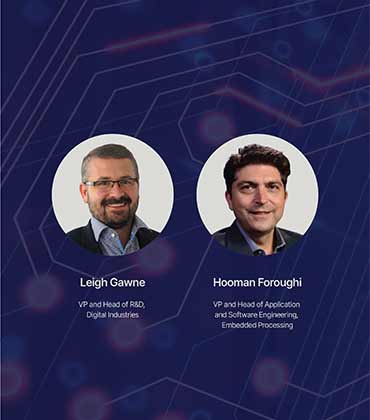
Leigh Gawne, VP, Head of R&D, Digital Industries, Hooman Foroughi, VP, Head of Application and Software Engineering, Embedded Processing
The embedded engineering sector remains one of the last industries to adopt full digital modernization, with hardware, software, and system design still operating in siloed and fragmented domains. Renesas Electronics Corporation addresses that gap through Renesas 365, powered by Altium, bringing its Digitalization Vision into an intelligently integrated cloud-based environment that connects silicon to system. Renesas 365 is a unified embedded system development platform that connects, rather than replaces, existing toolchains, integrating design intent, components, and workflows within a platform grounded in open-modeled components and contextual intelligence. Rather than forcing teams to reconcile separate environments late in development, it establishes digital continuity across domains from the outset. Establishing a Unified Design State Across Domains At the center of this shift is a shared and consistent design state. Concept definition, software development, and hardware design operate from a synchronized representation of the system, where intent carries across domains intelligently. Changes in one area are visible in others, allowing teams to identify design issues earlier, shift system integration left, and reduce rework. “We are reimagining the way embedded engineers go about designing software-defined products, bringing hardware, software, and system elements together across vendors to work as a unified ecosystem,” says Leigh Gawne, VP and Head of R&D, Digital Industries, at Renesas Electronics Corporation. The need for that shift is rooted in day-to-day engineering reality. Embedded teams still spend significant time resolving version mismatches, locating the right documentation, and configuring tools and environments before their actual system design begins. Renesas 365 targets that non-value-added burden by shifting more of that heavy lifting into the platform through modeled components, contextual awareness, and scenario evaluation. Designed as an open platform, its first implementation centers on the Renesas RA family of microcontrollers, with more than 550 MCU variants available within a model-based environment for system-aware exploration. Engineers begin by importing their existing projects or expressing design intent through freeform block diagrams in the Electronic System Designer, which the platform’s constraint modeling engine then interprets against modeled components to perform floor planning for on chip peripheral assignment and pin multiplexing, as well as additional capabilities such as power budgeting, memory consumption, and compute that will be available in the future. The platform also enables cross-probing between software and hardware domains, allowing a developer to navigate from a line of source code directly to a physical net or pin on the board. In the future, engineers can exercise what executives describe as the “power of what if,” evaluating configurations and exploring alternatives dynamically across power, memory, and performance constraints before committing to architectural decisions.
Semiconductor Manufacturing

Foremay
Advancing Rugged SSD Technologies for Mission-Critical Applications
Dennis Eodice, VP of Strategic Sales
Long before ruggedized SSDs became highly specialized for defense and aerospace use, Foremay recognized that controller and firmware architecture would determine how reliably solid-state storage could perform under extreme operating conditions. Founded in 2002, the company built its foundation around proprietary controller and firmware technologies, later extending that engineering focus into ruggedized SSD solutions for military, aerospace and emerging space-grade applications. This firmware specialization allows Foremay to customize SSD behavior around precise operational requirements, particularly where thermal limitations, vibration stress, radiation exposure and long-duration reliability concerns can directly impact system performance across defense, aerospace and satellite programs. “Our strength lies in our engineering capabilities and our ability to design SSDs around the precise operational requirements of each program,” says Dennis Eodice, VP of strategic sales.
Top AI Powered Photonic Chips Solution 2026
Lightmatter
Reengineering AI Infrastructure through Photonic Computing
Steve Klinger, VP of Ecosystem and Strategic Alliance
AI infrastructure providers are confronting growing limitations in bandwidth density, energy efficiency and data movement as frontier AI models continue scaling across larger compute clusters. Lightmatter built its photonic computing platform around solving interconnect bottleneck restricting the performance of traditional silicon architectures. “We are fundamentally reimagining the architecture of chips while supporting standardization across the ecosystem,” says Steve Klinger, VP of ecosystem and strategic alliance. Lightmatter’s Passage™ 3D co-packaged optics architecture is designed to overcome the bandwidth constraints created by traditional chip interconnects. Conventional systems remain limited because high-speed data transfer occurs only through the physical perimeter of chips, restricting bandwidth scalability as compute demands increase. It addresses this limitation by developing an edgeless I/O architecture allowing SerDes placement across the full surface of a chip through vertical optical integration. Passage™ delivers bandwidth density reaching up to 64 Tbps per chip while supporting optical distances of up to one kilometer. Lightmatter also introduced its Guide® light engine, which replaces manually assembled discrete laser modules with semiconductor-grade integrated photonic technology. This transition improves reliability, scalability and power efficiency while reducing the physical space required for optical infrastructure deployment.

Electronic Component Distributor

How to Prepare for the Future of Machine Vision
Paul Chen, Head of Global Electronics, TPM and Software Test, Mattel, Inc
Photonics

Test and Quality, Creston's Approach to Customer Loyalty
Ivan Farias, Senior Director, Production Operations, Crestron Electronics
Semiconductor Manufacturing

Trends to Watch in the 3D Era
Aaron Fellis, Corporate Vice President and General Manager of Dielectric ALD Products, Lam Research [NASDAQ: LRCX]
Semiconductor Manufacturing

Redefining the Automotive Sector with Innovative Manufacturing Systems
Trent Randles, Engineering & Operational Excellence Manager, BorgWarner
Electronic Component Distributor

Balancing Cost Lead Time and Quality Daily
Jill Wrucha-Munter, Commodity Manager-Electronic components, Fluke Corporation

IN MY OPINION
Electronic Contract Manufacturing
Modular MEP as the Blueprint for High-Tech Industrial Infrastructure
Bill Bullock, Sr. Vice President - Strategic Business Solutions, Manufacturing, Environmental Air Systems [NYSE:FIX]

LAST WORD
Semiconductor Packaging
The New Role of Semiconductors and Electrical Components
Juan Ontiveros, MTB Engineering Manager / Manufacturing Engineering Manager, ALPS ALPINE
IN FOCUS

Advancing Semiconductor Manufacturing with Fluororesin Technology
The production of semiconductor fluororesin products enhances the longevity of equipment, preserves cleanliness in cleanroom settings, and minimizes the risks of contamination.
Innovations in Semiconductor Engineering: Trends and Future Directions
Semiconductor engineering services enhance design precision, boost product performance, and strengthen product reliability.
EDITORIAL
Engineering tomorrow’s Semiconductor Systems
In this edition of Semiconductor Review, we examine how industry leaders are advancing chip design, photonic computing and manufacturing practices to meet the demands of next-generation technologies.
This edition features Marvell as the Top Custom Silicon and SystemLevel Connectivity Platform 2026. Its work in custom silicon and highperformance connectivity reflects the growing importance of purposebuilt computing platforms capable of supporting increasingly demanding enterprise and data-intensive workloads.
Renesas Electronics Corporation, recognized as Top PCB Design Software 2026, is helping reshape embedded engineering through the Renesas 365 platform. By unifying hardware, software and system design within a cloud-based engineering environment, the platform establishes digital continuity across development, enabling earlier integration, reducing rework and allowing engineers to focus on highervalue innovation rather than fragmented workflows.
Foremay, named Top Rugged Military SSD Drive Manufacturer 2026. Built on proprietary controller and firmware expertise, the company has established itself as a specialist in ruggedized solid-state storage for mission-critical defense, aerospace and emerging space applications.
This issue also honours Lightmatter as Top AI-Powered Photonic Chips Solution 2026. In an effort to address the challenges of bandwidth and power in the architecture of AI computing systems, the company has developed its own computing technology that enables better communication between computer clusters.
Our CXO contributors explore the broader forces shaping semiconductor manufacturing and advanced engineering. Juan Ontiveros, MTB Engineering Manager / Manufacturing Engineering Manager at ALPS ALPINE, discusses the growing importance of semiconductors, electronic components and robust quality controls as AI, automation and connected technologies transform modern industry. Trent Randles, Engineering Manager at BorgWarner, highlights how digital technologies, strategic planning and cross-functional collaboration enable manufacturers to improve operational efficiency while successfully integrating advanced manufacturing systems.
All these stories clearly illustrate how the future of the semiconductor industry is connected to engineering integration, proper implementation, and development. We encourage you to read about this topic and learn how innovations and leaders' views shape the future of semiconductors.
This content is copyright protected
However, if you would like to share the information in this article, you may use the link below:
https://www.semiconductorreview.com/edition/july-2026-45.html