

Thank you for Subscribing to Semiconductor Review Weekly Brief
× 
Semi Conductor Review Weekly Brief
Be first to read the latest tech news, Industry Leader's Insights, and CIO interviews of medium and large enterprises exclusively from Semi Conductor Review
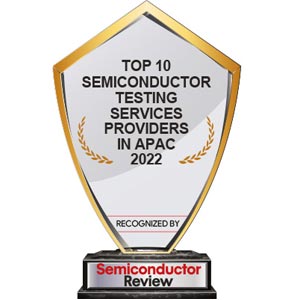
TTS Group has been recognized by Semiconductor Review Magazine as “Top 10 Semiconductor Testing Services Companies in APAC - 2022” based on our proprietary methodology, reflecting its position in the industry. This profile has been developed by the Semiconductor Review research and editorial team based on insights from an interview with Daniel Ow, Sales Director.


As increasingly complicated devices force test equipment providers to constantly develop and stay up with today’s fast-paced demands, the semiconductor testing industry is facing new problems. Cost of testing, enhancing the quality of the test program, and not limiting the productivity of designers will continue to be major difficulties to overcome for semiconductor test product vendors.
Since 1979, Test Tooling Solutions Group (TTS Group) has been committed to providing the best available solutions to assist its customers in solving some of the most difficult challenges in semiconductor test and tooling. The company focuses on minimizing the total cost of final tests including R&D, design, simulation, and validation by relentlessly pursuing innovation, yield, quality, reliability, and on-time delivery for customers. They recognize their customers’ needs and provide a one-stop shop for all of their issues.
The company extends solutions to eliminate the issues that a device under test (DUT) encounters during the testing phase. For instance, when current from the test system travels through the device under test (DUT), heat is created. If there isn’t a proper thermal solution, it can harm the DUT’s performance. Excessive heat may cause the DUT’s functioning speed to slow down. Smoke may be emitted in the worst-case scenario, and the DUT may be burned and melted into the test socket. Thermal analysis is used to investigate temperature distribution and heat transfer between systems to suggest a solution for keeping the DUT at or below the specified temperature during testing.
TTS Group uses the Computational Fluid Dynamics (CFD) method to simulate the heat transfer between the DUT, the hand socket lid, and the test socket at the design stage, using a set of boundary conditions and a steady-state or transient response.
Transient thermal analysis is a time-dependent examination of the heat flow, whereas steady-state thermal analysis is a linear static analysis where the heat flow does not fluctuate over time.
Furthermore, TTS Group also manufactures various reliable products such as pogo pins, test sockets, and hand socket lids, specially designed for different testing conditions. As a socket tester, the company has a dedicated Test & Validation unit to test and validate probe pins whilst still in the development process. A comprehensive range of the test is carried out to produce objective evidence of the performance and reliability of pins. This evidence is collated from a series of tests; cycling test, CRES test, force resistance displacement, current carrying capability, SEM inspection, and x-ray inspection.
In a semiconductor test system, the test probe plays an essential role. The major task is to ensure high-speed signals transfer between the test socket and the device under test (DUT) with minimal attenuation and signal degradation. This electrical performance can be examined using a Signal Integrity (SI) analysis to aid in the selection of the optimal test probe for various testing environments. TTS Group uses Ansoft HFSS (High-Frequency Structure Simulator) and Ansoft Designer as the primary tools to investigate and obtain precise SI solutions for test probes.
The Ansoft HFSS software is used to create a 3D structure in which the simulation is based on the actual dimensions of testing, such as the connection between the IC package, test probe, socket, and PCB testing. Insertion Loss, Return Loss, Crosstalk, Inductance, Capacitance, and Impedance are some of the S-parameter outputs from the simulation. On the other hand, Ansoft Designer software is used for 2D structure (planar) to convert and simulate S-Parameters from HFSS 3D for run time domain reflectometry (TDR) analysis.
-
TTS Group uses the Computational Fluid Dynamics (CFD) method to simulate the heat transfer between the DUT, the hand socket lid, and the test socket at the design stage, using a set of boundary conditions and a steady-state or transient response
Furthermore, TTS Group also manufactures various reliable products such as pogo pins, test sockets, and hand socket lids, specially designed for different testing conditions. As a socket tester, the company has a dedicated Test & Validation unit to test and validate probe pins whilst still in the development process. A comprehensive range of the test is carried out to produce objective evidence of the performance and reliability of pins. This evidence is collated from a series of tests; cycling test, CRES test, force resistance displacement, current carrying capability, SEM inspection, and x-ray inspection.
With a vision to become a leading semiconductor test tooling solutions provider in Asia, TSS Group is constantly creating value for its stakeholders by reducing the total cost of tests and shortening the time to market for customers.
| Share this Article:Tweet
|
Company
TTS Group
Management
Daniel Ow, Sales Director
Description
TTS Group focuses on minimizing the total cost of final tests including R&D, design, simulation, and validation by relentlessly pursuing innovation, yield, quality, reliability, and on-time delivery for customers

This content is copyright protected
However, if you would like to share the information in this article, you may use the link below: