


Thank you for Subscribing to Semiconductor Review Weekly Brief
× 
Semi Conductor Review Weekly Brief
Be first to read the latest tech news, Industry Leader's Insights, and CIO interviews of medium and large enterprises exclusively from Semi Conductor Review
Teradyne has been recognized by Semiconductor Review Magazine as the exclusive recipient of “Top Semiconductor Test & Robotic Solutions 2026,” based on our proprietary methodology, reflecting its position in the industry, and is also named among “Top Testing and Quality Assurance Companies,” reflecting its broader leadership. This profile has been developed by the Semiconductor Review research and editorial team based on insights from an interview with Greg Smith, President and CEO.


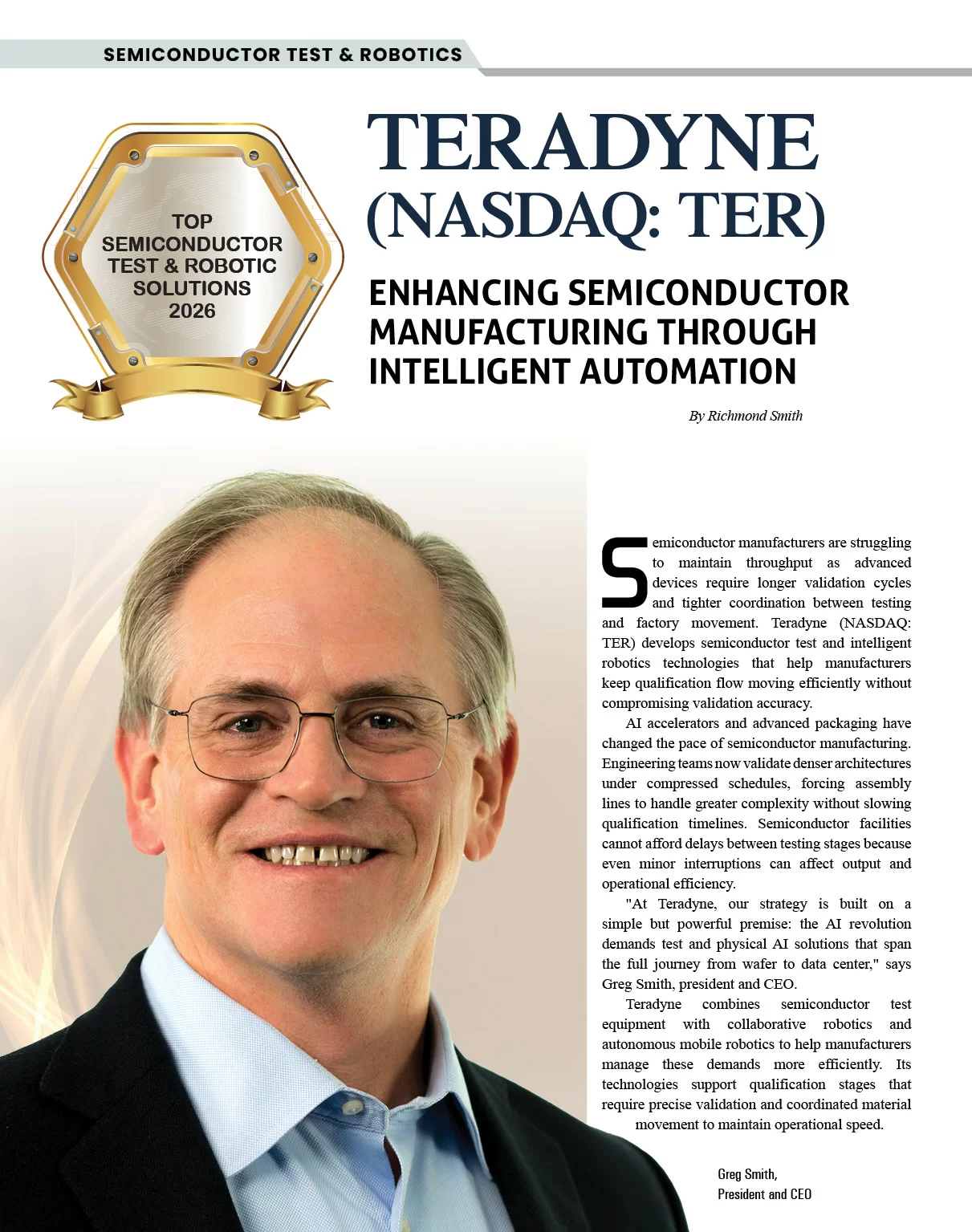
 Greg Smith, President and CEO
AI accelerators and advanced packaging have changed the pace of semiconductor manufacturing. Engineering teams now validate denser architectures under compressed schedules, forcing assembly lines to handle greater complexity without slowing qualification timelines. Semiconductor facilities cannot afford delays between testing stages because even minor interruptions can affect output and operational efficiency.
"At Teradyne, our strategy is built on a simple but powerful premise: the AI revolution demands test and physical AI solutions that span the full journey from wafer to data center," says Greg Smith, president and CEO.
Teradyne combines semiconductor test equipment with collaborative robotics and autonomous mobile robotics to help manufacturers manage these demands more efficiently. Its technologies support qualification stages that require precise validation and coordinated material movement to maintain operational speed.
Semiconductor Test Systems Designed for Device Complexity
Teradyne’s test portfolio covers wafer sort, final test and system-level validation for memory, analog, mixed-signal and system-on-chip applications. Its platforms allow engineering teams to shift between qualification programs without replacing large sections of test hardware, helping customers manage changing qualification requirements more efficiently.
Demand for high-performance computing has also increased the volume of data generated during semiconductor validation. Processors designed for AI workloads require more advanced signal analysis under increasingly demanding electrical conditions. Teradyne continues expanding test capabilities that support these compute-intensive applications and evolving semiconductor architectures.
Semiconductor companies also handle a broader mix of devices than in previous qualification cycles. Automotive electronics, industrial systems and consumer computing products all require different qualification methods. Engineering teams, therefore, need test infrastructure that adapts quickly without reducing throughput or disrupting qualification schedules.
At Teradyne, our strategy is built on a simple but powerful premise: the AI revolution demands test and physical AI solutions that span the full journey from wafer to data center.
Intelligent Robotics Supporting Manufacturing Flow
Teradyne’s robotics technologies support factory operations that can no longer depend on fixed automation designed for repetitive workflows. Semiconductor facilities now manage faster product transitions, higher movement frequency and greater variability between qualification stages. These conditions require automation systems that respond quickly without interrupting workflow timing.
Through Universal Robots, Teradyne develops collaborative robotics systems that support inspection, machine tending and material handling inside semiconductor and electronics facilities. The systems operate alongside facility personnel and help reduce repetitive movement that slows engineering workflows or increases manual strain.
Semiconductor manufacturers often need robotics systems that integrate into existing factory workflows without lengthy deployment cycles or extensive programming requirements. Teradyne supports faster implementation through robotics interfaces that simplify customization and reduce integration complexity.
Its autonomous mobile robotics technologies, developed through Mobile Industrial Robots, help semiconductor manufacturers coordinate movement between qualification stages more efficiently. Semiconductor operations depend heavily on the timely transport of tooling, materials and qualified components. The company’s mobile robotics systems help reduce transport delays that can interrupt factory schedules.
Teradyne continues strengthening robotics capabilities through AI-driven navigation and adaptive movement technologies. Robotics systems now respond more effectively to changing factory conditions through route optimization and real-time obstacle adjustment. These capabilities help manufacturers maintain workflow continuity inside high-volume semiconductor operations.
The robotics portfolio supports a broader automation strategy focused on operational responsiveness and coordination. Collaborative robotics and autonomous mobility technologies help manufacturers manage material movement more efficiently without relying heavily on manual intervention.
“As the industry races to maximize production of AI-accelerated servers at the highest quality levels, our robots bring the flexibility and precision to maximize build quality, while our test solutions detect defects as early as possible,” says Smith.
It combines automated test equipment with robotics systems that support movement between testing stages. Autonomous mobile robots transport materials and components through qualification processes with greater consistency, helping manufacturers reduce idle time between qualification stages.
Connecting Validation and Production Coordination
Teradyne connects semiconductor test infrastructure with intelligent automation technologies that support workflow coordination throughout modern industrial operations. Semiconductor manufacturing depends on constant synchronization between validation stages and material movement. Delays between these processes can quickly reduce throughput and disrupt scheduling.
-
As the industry races to maximize production of AI-accelerated servers at the highest quality levels, our robots bring the flexibility and precision to maximize build quality, while our test solutions detect defects as early as possible.
It combines automated test equipment with robotics systems that support movement between testing stages. Autonomous mobile robots transport materials and components through qualification processes with greater consistency, helping manufacturers reduce idle time between qualification stages.
Collaborative robotics systems also support repetitive handling tasks surrounding semiconductor validation. Human operators continue managing engineering-critical decisions, yet robotics systems reduce the manual burden associated with loading and movement activities. This balance allows manufacturers to sustain efficiency without compromising precision.
Semiconductor manufacturers also need infrastructure that adapts to changing qualification demands without requiring major workflow redesign. Packaging methods and device architectures continue evolving rapidly, forcing facilities to adjust workflows more frequently than before. Teradyne addresses these transitions through configurable systems that adapt more efficiently to changing qualification requirements.
Many semiconductor facilities also operate equipment from multiple vendors inside the same workflow structure. Communication gaps between robotics systems and factory tools can complicate workflow coordination and reduce visibility into factory activity. Teradyne supports open integration capabilities that simplify communication between these technologies.
Manufacturers depend more heavily on validation data and workflow visibility to improve factory performance. Teradyne connects automation coordination with semiconductor test intelligence to help manufacturers maintain throughput and improve operational efficiency under increasingly demanding conditions.
Reliability as a Manufacturing Requirement
Semiconductor manufacturing places enormous importance on reliability because workflow interruptions can create qualification delays and significant output losses. Engineering teams, therefore, evaluate consistency and long-term system stability alongside automation capability when selecting semiconductor test and robotics technologies.
Teradyne focuses heavily on reliability within both semiconductor test systems and intelligent robotics technologies. Its validation platforms support continuous qualification workloads that require sustained precision during demanding qualification cycles and high-volume operating schedules.
The robotics business follows a similar approach centered on dependable automation performance. Collaborative robots and autonomous mobile systems must function predictably inside factory operations containing sensitive equipment and tightly coordinated workflows. Teradyne strengthens robotics responsiveness through investment in AI capabilities and software intelligence.
It has also strengthened coordination between collaborative robotics and autonomous mobility technologies as semiconductor manufacturers pursue more integrated automation support systems. This alignment reflects growing demand for automation platforms that improve responsiveness without disrupting workflow continuity.
As semiconductor manufacturing continues evolving, Teradyne continues developing semiconductor test and intelligent automation technologies that support faster validation cycles and more coordinated operational flow. Its recognition as the Top Semiconductor Test & Robotic Solutions 2026 reflects the growing importance of tightly integrated test and automation technologies within modern semiconductor manufacturing.
Choosing Semiconductor test and Robotics Systems for Throughput Control
Longer validation cycles are forcing semiconductor factories to examine a cost that rarely appears cleanly on a procurement sheet: the time lost among test readiness, tool availability, engineering bandwidth and material movement. Advanced packaging, AI processors, automotive electronics and mixed-signal devices have widened the range of qualification work inside the same facility. A test cell may be technically capable, yet throughput still suffers when device programs shift faster than handlers and factory logistics can adjust. That pressure often shows up as idle equipment rather than an obvious planning failure.
The buying question is no longer confined to tester performance. Executives responsible for semiconductor test and robotics systems need to understand how a platform behaves when product mix changes and validation data expands while factory movement becomes a constraint on output. Hardware flexibility matters because qualification programs cannot wait for major reconfiguration every time a device family changes. The test environment should support wafer sort, final test, system-level validation and diagnostic review while allowing engineering teams to move between device requirements with limited disruption.
Diagnostic visibility carries equal weight. AI accelerators and dense system-on-chip designs produce large volumes of validation data under demanding electrical conditions. Engineers need earlier anomaly detection, clearer failure analysis, yield-behavior context and a practical way to connect test results to process variation. A system that only records pass-fail results leaves too much interpretation for later review. Better infrastructure helps teams identify variation while the qualification window is still open.
Factory movement has become part of the same purchase logic. Semiconductor facilities often lose time in the handoff between test stages, especially when materials or qualified components depend on manual transport. Robotics should reduce that drag without forcing the factory into a redesign. Collaborative robots must be practical for inspection and machine tending, while autonomous mobile robots should coordinate transport across existing floor layouts, adjust to changing routes, respond to obstacles and reduce waiting time around qualification flow.
Integration is where many automation programs lose momentum. Test equipment, robotics systems, factory software and data tools frequently come from different vendors, making communication gaps a real production issue. Buyers should press for open integration and clear status data. Deployment paths also matter, especially when custom work stretches past the point of early value. Reliability remains nonnegotiable, since a robot or tester that adds downtime during a qualification push creates the problem it was purchased to solve.
Teradyne fits this buying logic because it brings semiconductor test equipment and intelligent robotics into one portfolio relevant to validation and factory flow. Its test systems support wafer sort, final test, system-level validation and broader device qualification for memory, analog, mixed-signal and system-onchip applications. Universal Robots gives it collaborative robots suited to machine tending and inspection work. Mobile Industrial Robots supports autonomous transport inside manufacturing environments. Teradyne’s emphasis on analytics, adaptable test platforms, collaborative automation and mobile robotics gives semiconductor executives a practical route to connect validation accuracy with steadier factory coordination. For buyers trying to reduce qualification delays without separating test decisions from movement constraints, it deserves close evaluation.
...Read more
Semiconductor Test and Robotic Solutions Info
Q1
What Should Manufacturers Expect From Semiconductor Test & Robotic Solutions?
Semiconductor Test & Robotic Solutions should help manufacturers validate complex devices while keeping factory movement from becoming a bottleneck. The category covers test systems, robotics and workflow coordination that support qualification from wafer-level checks to later production stages. Strong solutions make it easier to handle dense chip designs, varied device types and rising data volumes without slowing every engineering change.
Q2
How Does Teradyne Connect Testing and Factory Automation?
Longer validation cycles can leave expensive equipment waiting if materials, tooling or components do not move on time. Teradyne brings Semiconductor Test & Robotic Solutions together through automated test equipment, collaborative robotics and autonomous mobile robotics. Its test portfolio supports wafer sort, final test and system-level validation across memory, analog, mixed-signal and system-on-chip applications. Through Universal Robots and Mobile Industrial Robots, it also supports inspection, machine tending, material handling and coordinated transport between qualification stages.
Q3
Why Does Robotics Matter in Semiconductor Validation?
Robotics is important because accurate testing alone is not enough to keep production moving. Semiconductor Test & Robotic Solutions should also cut down on repetitive tasks, improve timing, and help teams avoid delays between steps. Collaborative robots can work safely near people and machines, while mobile robots move materials through the facility more reliably. This is important because even small delays can lead to missed production deadlines.
Q4
What Quality Factors Should Buyers Review?
Buyers should look beyond headline automation claims and review how Semiconductor Test & Robotic Solutions behave under real qualification pressure. A useful review should include test coverage, diagnostic visibility, integration with existing tools, changeover flexibility and service access. It also helps to test a workflow with a real device program rather than relying only on a demonstration. The system has to handle revisions, not just ideal conditions.
Q5
How Do These Solutions Support Advanced Packaging and AI Chips?
Advanced packaging and AI-focused devices create more demanding validation work because they bring denser architectures, tighter electrical requirements and heavier data analysis. Semiconductor Test & Robotic Solutions help by pairing precise device testing with factory automation that keeps the process moving. Engineers need visibility into anomalies and process variation early, while production teams need equipment movement that does not add extra waiting time.
Q6
What Role Does Integration Play in Long-Term Performance?
Integration determines whether automation becomes useful or just another system to manage. Semiconductor Test & Robotic Solutions should communicate with factory tools, support mixed-vendor environments and adapt as qualification requirements change. Open integration, configurable test infrastructure and predictable robot behavior reduce the friction that often appears when teams add automation around existing semiconductor workflows. Reliability is not only a product trait; it is something the full workflow has to prove.
| Share this Article:Tweet
|
Company
Teradyne
Management
Greg Smith, President and CEO
Description
Teradyne develops semiconductor test equipment and intelligent robotics technologies for electronics and industrial sectors. Its portfolio includes automated test systems, collaborative robots and autonomous mobile robotics supporting device validation, material movement, automation efficiency and coordinated workflows for semiconductor and industrial applications.
This content is copyright protected
However, if you would like to share the information in this article, you may use the link below: