
Thank you for Subscribing to Semiconductor Review Weekly Brief
× 
Semi Conductor Review Weekly Brief
Be first to read the latest tech news, Industry Leader's Insights, and CIO interviews of medium and large enterprises exclusively from Semi Conductor Review
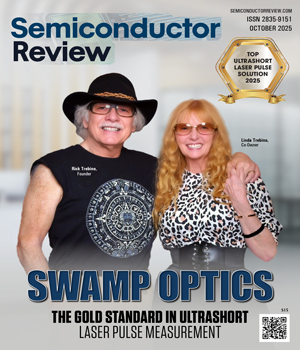
Swamp Optics has been recognized by Semiconductor Review Magazine as “Top Ultrashort Laser Pulse Solution 2025” based on our proprietary methodology, reflecting its position in the industry. This profile has been developed by the Semiconductor Review research and editorial team based on insights from an interview with Rick Trebino, Founder and Linda Trebino, Co-Owner.



Swamp Optics
The Gold Standard in Ultrashort Laser Pulse Measurement

 Rick Trebino, Founder and Linda Trebino, Co-Owner
For decades, the best that could be done was “autocorrelation,” which provided only a blurry black-and-white snapshot of the pulse in time. Worse, when pulses had unstable intensity shapes vs. time, autocorrelation had a notorious artifact, called the “coherent artifact,” which yielded an erroneously short pulse. As instability is almost a way of life with ultrafast lasers, this was quite problematic.
The complete artifact-free temporal measurement of such pulses became a famous unsolved—perhaps even unsolvable—problem.
But, in a truly inspired insight, Rick Trebino solved it. He noted that, by measuring a novel type of spectrogram of the pulse that used the pulse to gate itself in time and then employing sophisticated phase-retrieval mathematics, borrowed from astronomical imaging, he could completely reconstruct the pulse in time. This yielded a high-resolution full-color image of the pulse in time. He called his device Frequency-Resolved Optical Gating, or FROG.
"The vast majority of science’s greatest discoveries have resulted directly from more powerful light-measurement techniques, and FROG and GRENOUILLE are, without question, more powerful light-measurement techniques"
Features that had once seemed immeasurable—few-femtosecond intensity and phase variations—came into sharp focus. Even better, FROG doesn’t suffer from the coherent artifact. Indeed, because it provides so much more information in its measurement vs. time and frequency, FROG also clearly indicates the presence of pulse-shape instability or confirms its absence.
The Instrument that Made Ultrafast Accurate
The earliest FROG devices were groundbreaking in capability, but complex (like most other optical devices), requiring the steady hands and deep expertise of trained experimentalists. So, Rick then introduced a very clever, highly simplified version of FROG that he called GRENOUILLE (the French word for “frog”). GRENOUILLE reduces the entire FROG apparatus to an alignment-free monolithic block of only four simple optics plus a camera. The resulting device never misaligns, even in a hostile environment. Although compact in size, it is remarkably effective, operating multi- or single shot and yielding the pulse nearly instantaneously. For laser labs accustomed to highly complex apparatuses, painstaking daily realignment procedures and tediously slow data collection, this was revolutionary.
With his wife, Linda, Rick founded Swamp Optics (of course; frogs live in swamps) to bring these breakthroughs to the research and engineering communities. GRENOUILLE gave the ultrafast optics community a truly convenient way to know their pulses to a quintillionth of a second.
“Rick’s a physics professor, but he’s also fascinated by the psychology of everyday things, so he invented a device once thought impossible and then made it a simple everyday thing,” says Linda.
Both FROG and GRENOUILLE immediately became and remain the gold standards of pulse measurement, playing key roles even in Nobel-Prize research efforts.
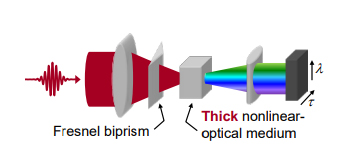 While alternative devices have since been introduced by others, none have achieved the accuracy and completeness of FROG or the simplicity and reliability of GRENOUILLE. Worse, many comprise complex interferometric apparatuses with severe coherent-artifact issues (among other problems). In fact, one, called SPIDER, cannot distinguish a stable train of short simple pulses (the most desirable case) from its diametrically opposite case, an unstable train of long complex pulses (by far, the least desirable case). As in autocorrelation, pulse-shape instability causes it to yield an erroneously short pulse. Unfortunately, this serious flaw is often seen as desirable by scoundrels, so such methods remain common.
Diagnosing Lasers at the Speed of Insight
GRENOUILLE’s immediate advantages were full temporal information, simplicity and stability. But Rick added components to also measure the beam’s spatial profile, which also solved another ubiquitous optical-device complication: it vastly simplified alignment of the laser beam into the device. Then, quite remarkably, Rick realized that GRENOUILLE also measured additional important common pulse distortions that were otherwise quite difficult to measure and so nearly always went unmeasured.
These distortions, called “spatiotemporal couplings,” indicate how the pulse behaves in time and space. One such distortion, “pulse-front tilt,” indicates that the pulse is literally tilted. Another, “spatial chirp,” means that different colors disperse across the beam. Both effects lower pulse intensity and distort a beam’s focus—especially problematic in applications like micromachining, microscopy and laser surgery, where high intensity and micron accuracy matter greatly. And GRENOUILLE just happened to also measure them.
One of the clearest proofs of GRENOUILLE’s power occurred in the work of Peter Kazansky, a prominent researcher in ultrafast laser micromachining. He had observed groove patterns that depended on the scan direction of his laser beam across a surface. But he smartly noted that GRENOUILLE indicated a very small—but measurable—pulse-front tilt in his pulses. With this observation, he had discovered “quill writing,” a new type of micromachining based specifically on pulse-front tilt. Without GRENOUILLE, this important discovery might have gone unnoticed.
“The vast majority of science’s greatest discoveries have resulted directly from more powerful light-measurement techniques,” Rick explains. “And FROG and GRENOUILLE are, without question, more powerful light-measurement techniques.”
-
Rick’s a physics professor, but he’s also fascinated by the psychology of everyday things, so he invented a device once thought impossible and then made it a simple everyday thing
“The vast majority of science’s greatest discoveries have resulted directly from more powerful light-measurement techniques,” Rick explains. “And FROG and GRENOUILLE are, without question, more powerful light-measurement techniques.”
Trusted by the Toughest Labs and Industries
Since ultrashort-pulse lasers can be finicky—and stealthily so—their misbehavior can wreak havoc in any application. Fortunately, GRENOUILLE conveniently provides the most complete diagnostic available for them and so serves as the standard diagnostic in nearly all ultrafast-optical settings. Laser manufacturers rely on it to spot performance issues early, avoiding costly downtime and hardware failures. In multiphoton microscopy, GRENOUILLE is critical because the shorter the pulse, the better the contrast in the resulting image. Universities have adopted it as a teaching instrument, providing students with hands-on experience in real-world pulse diagnostics and eliminating the painful learning curve that once limited such measurements to specialists. In micromachining, it ensures that high-precision cuts remain consistent across production runs.
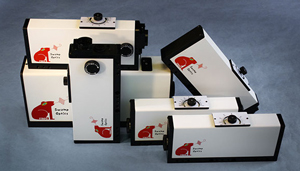 GRENOUILLE enables on-site diagnostics in aerospace facilities, industrial production lines, photonics manufacturing plants and defense environments, where precision laser performance is critical. For example, Lawrence Livermore National Laboratory uses GRENOUILLE for high-energy laser diagnostics. MIT Lincoln Laboratory uses it in advanced laser system development. In Germany, the Max Planck Institute for Quantum Optics applies it to precision ultrafast measurements, while the CEA in France turns to it for its high-intensity laser diagnostics.
Tying these fields together is the need for absolute confidence in the measurement. GRENOUILLE devices have run for more than 20 years without recalibration or modification, proof of the device’s extreme reliability. Combined with zero maintenance and unmatched pulse-distortion detection, that reliability has made it the trusted choice for organizations that cannot afford uncertainty.
Indeed, because GRENOUILLE records a FROG trace for literally every pulse, actually building a GRENOUILLE into an ultrafast laser system can prevent potentially large expenses due to a ruined sample or, worse, an injured patient, resulting from laser misbehavior.
A Quiet Referee of Ultrafast Optics
Swamp Optics’ credibility is clear from its devices’ adoption by the most demanding names in science. As a result, FROG and GRENOUILLE have been cited in tens of thousands of peer-reviewed papers, and Rick’s original FROG papers are some of the most cited in optics. Rick also literally wrote the book on the subject of pulse measurement, and it’s one of the most popular and cited monographs in optics. Indeed, ScholarGPS, an agency that objectively ranks scientists in all fields, ranks Rick the #1 scientist of all ~21,000 ultrashort-pulse scientists. He’s actually run out of room on his office walls and shelves for the plaques and prizes he’s won for his work.
That reputation is backed by a Swamp Optics team that has intentionally remained small. Rick continues to lead technical innovation in the field, having developed devices to measure the most temporally complex pulses ever generated and complex pulses completely in space and time, offering his assistance for free to those with unusual needs. Linda ensures that the business runs with the same precision as the instruments they ship, handling everything from operations to customer relationships, where her sunny disposition and prompt responses consistently earn praise. When you call Swamp Optics, you get a human—one who actually cares. Problems rarely occur, but when one does, it’s usually resolved in a single phone call or email, even at odd hours of the day.
Swamp Optics sells directly to customers around the world and supports them with a dedication not often experienced in our time. It has sold devices to over 40 countries across every continent, except Antarctica.
In a few short decades, ultrashort laser pulses have advanced from exotic scientific novelties to practical tools with a wide variety of important applications. But these applications are only meaningful if the pulses can be trusted. Swamp Optics chose to provide the mechanism to ensure that trust. It has set the standard for measuring ultrashort laser pulses, and its devices are everywhere, ensuring that every pulse is precisely what it needs to be.
| Share this Article:Tweet
|
Company
Swamp Optics
Management
Rick Trebino, Founder and Linda Trebino, Co-Owner
Description
Swamp Optics, led by Rick and Linda Trebino, created GRENOUILLE, the gold standard for ultrashort laser pulse measurement. Trusted by top labs worldwide, GRENOUILLE is ultrareliable and easy to use. They sell honest confidence: the certainty that every pulse is measured correctly and as completely as possible, every time.
This content is copyright protected
However, if you would like to share the information in this article, you may use the link below: