
Thank you for Subscribing to Semiconductor Review Weekly Brief
× 
Semi Conductor Review Weekly Brief
Be first to read the latest tech news, Industry Leader's Insights, and CIO interviews of medium and large enterprises exclusively from Semi Conductor Review
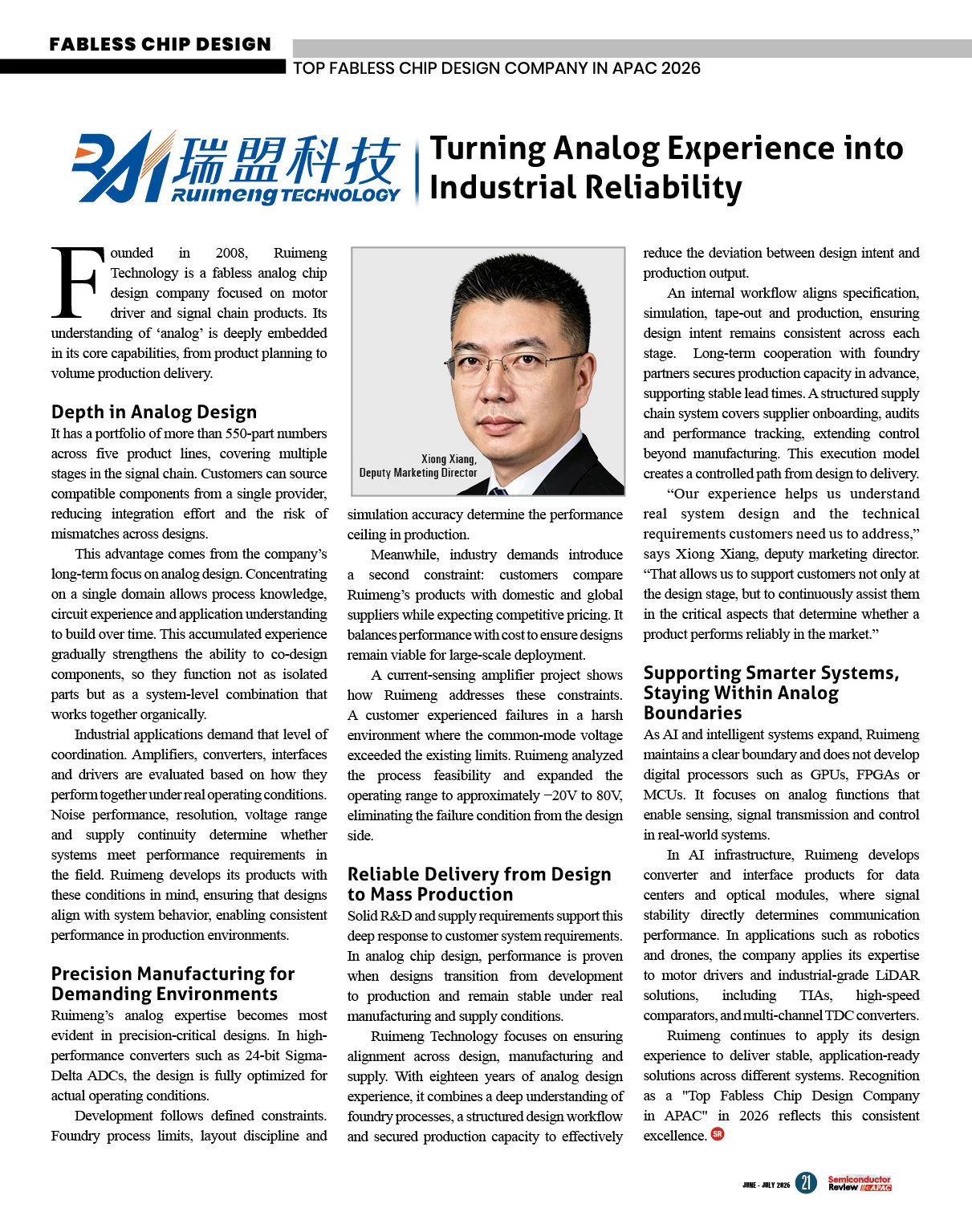
has been recognized by Semiconductor Review Magazine as the exclusive recipient of “Top Fabless Chip Design Company in APAC 2026,” based on our proprietary methodology, reflecting its position in the industry, and is also named among “Top Semiconductor Manufacturing Services In APAC,” reflecting its broader leadership. This profile has been developed by the Semiconductor Review research and editorial team based on insights from an interview with Xiong Xiang, Deputy Marketing Director.



Ruimeng Technology
Turning Analog Experience into Industrial Reliability

 Xiong Xiang, Deputy Marketing Director
Depth in Analog Design
It has a portfolio of more than 550-part numbers across five product lines, covering multiple stages in the signal chain. Customers can source compatible components from a single provider, reducing integration effort and the risk of mismatches across designs.
This advantage comes from the company’s long-term focus on analog design. Concentrating on a single domain allows process knowledge, circuit experience and application understanding to build over time. This accumulated experience gradually strengthens the ability to co-design components, so they function not as isolated parts but as a system-level combination that works together organically.
Industrial applications demand that level of coordination. Amplifiers, converters, interfaces and drivers are evaluated based on how they perform together under real operating conditions. Noise performance, resolution, voltage range and supply continuity determine whether systems meet performance requirements in the field. Ruimeng develops its products with these conditions in mind, ensuring that designs align with system behavior, enabling consistent performance in production environments.
Precision Manufacturing for Demanding Environments
Ruimeng’s analog expertise becomes most evident in precision-critical designs. In high-performance converters such as 24-bit Sigma-Delta ADCs, the design is fully optimized for actual operating conditions.
Development follows defined constraints. Foundry process limits, layout discipline and simulation accuracy determine the performance ceiling in production.
Meanwhile, industry demands introduce a second constraint: customers compare Ruimeng’s products with domestic and global suppliers while expecting competitive pricing. It balances performance with cost to ensure designs remain viable for large-scale deployment.
-
Our experience helps us understand real system design and the technical requirements customers need us to address.
A current-sensing amplifier project shows how Ruimeng addresses these constraints. A customer experienced failures in a harsh environment where the common-mode voltage exceeded the existing limits. Ruimeng analyzed the process feasibility and expanded the operating range to approximately −20V to 80V, eliminating the failure condition from the design side.
Reliable Delivery from Design to Mass Production
Solid R&D and supply requirements support this deep response to customer system requirements. In analog chip design, performance is proven when designs transition from development to production and remain stable under real manufacturing and supply conditions.
Ruimeng Technology focuses on ensuring alignment across design, manufacturing and supply. With eighteen years of analog design experience, it combines a deep understanding of foundry processes, a structured design workflow and secured production capacity to effectively reduce the deviation between design intent and production output.
An internal workflow aligns specification, simulation, tape-out and production, ensuring design intent remains consistent across each stage. Long-term cooperation with foundry partners secures production capacity in advance, supporting stable lead times. A structured supply chain system covers supplier onboarding, audits and performance tracking, extending control beyond manufacturing. This execution model creates a controlled path from design to delivery.
“Our experience helps us understand real system design and the technical requirements customers need us to address,” says Xiong Xiang, deputy marketing director. “That allows us to support customers not only at the design stage, but to continuously assist them in the critical aspects that determine whether a product performs reliably in the market.”
Supporting Smarter Systems, Staying Within Analog Boundaries
As AI and intelligent systems expand, Ruimeng maintains a clear boundary and does not develop digital processors such as GPUs, FPGAs or MCUs. It focuses on analog functions that enable sensing, signal transmission and control in real-world systems.
In AI infrastructure, Ruimeng develops converter and interface products for data centers and optical modules, where signal stability directly determines communication performance. In applications such as robotics and drones, the company applies its expertise to motor drivers and industrial-grade LiDAR solutions, including TIAs, high-speed comparators, and multi-channel TDC converters.
Ruimeng continues to apply its design experience to deliver stable, application-ready solutions across different systems. Recognition as a "Top Fabless Chip Design Company in APAC" in 2026 reflects this consistent excellence.
Precision and Continuity in Fabless Analog Chip Design
Semiconductor buyers evaluating fabless chip design firms face a market shaped by increasing demand for precision, supply predictability and application-specific integration. Industrial systems, communications infrastructure and emerging intelligent devices depend less on isolated components and more on tightly aligned signal chains that preserve data integrity from sensing to processing. In this environment, differentiation is rarely driven by breadth alone. It emerges from how effectively a design partner balances deep technical expertise with production continuity and real-world system understanding.
Analog and signal chain design presents a distinct challenge compared to digital domains. Performance is constrained not only by architecture but also by foundry processes, environmental variability and accumulated design experience. Achieving high-resolution conversion or low-noise amplification in industrial conditions requires consistent refinement of workflows and a disciplined approach to design accuracy. Buyers increasingly prioritize partners that demonstrate repeatability in production outcomes, not just theoretical performance benchmarks. Consistency across fabrication cycles becomes as critical as peak capability.
Supply stability has also moved to the forefront of executive decision-making. Semiconductor disruptions have exposed the risks of fragmented sourcing and reactive capacity planning. Fabless firms that maintain structured, long-term relationships with foundries and align their design cycles with production realities offer a measurable advantage. Lead times, geographic proximity of manufacturing and governance over supply chains directly influence deployment timelines for end customers. Buyers no longer treat these as secondary considerations; they are central to operational continuity.
Another shift lies in how chips are conceived within broader systems. Enterprises are less inclined to integrate standalone components from multiple vendors when signal chain coherence can be achieved through a unified design perspective. A partner that understands amplifiers, converters, interfaces and drivers as interconnected elements can anticipate parameter dependencies and optimize performance at the system level. This approach reduces integration friction and allows engineering teams to engage in more meaningful technical dialogue, grounded in actual application conditions rather than abstract specifications.
Cost-performance balance remains an unavoidable tension. Competitive pressure, especially in fast-growing regional markets, forces buyers to weigh premium performance against pricing discipline. Firms that can manage process selection, design efficiency and production economics without compromising output quality position themselves more favorably. The ability to deliver high-performing solutions while maintaining cost awareness reflects maturity in both engineering and commercial strategy. It also signals an understanding of long-term customer relationships rather than short-term transactional wins.
Ruimeng Technology aligns closely with these expectations through its sustained focus on analog and signal chain design. It has built its capabilities over more than a decade of concentrated development, refining internal workflows to support design accuracy and production consistency. Its portfolio spans amplifiers, converters, interfaces and motor drivers, allowing it to engage with customers at the system level rather than as a single-function supplier. The company’s long-term cooperation with foundries supports stable capacity planning and competitive lead times, particularly within its domestic supply network. Its solutions address industrial performance demands such as noise control, resolution accuracy and tolerance to harsh operating conditions, demonstrated through targeted designs like high-range current sensing amplifiers. For buyers seeking a disciplined analog specialist capable of balancing precision, integration and supply continuity, it presents a credible and focused choice.
...Read more
Fabless Chip Design Companies in APAC Info
Q1
What Should Buyers Expect from Fabless Chip Design Companies?
Fabless Chip Design Companies should do more than design chips and hand them off for manufacturing. In analog applications, buyers need a partner that understands real-world challenges such as noise, voltage range, power stability and signal integrity. The value comes from connecting product planning, circuit design and production readiness so chips perform reliably outside the lab. That becomes especially important when moving from prototypes to large-scale deployment without costly redesigns.
Q2
How Does Ruimeng Technology Reflect This Category?
Ruimeng Technology reflects Fabless Chip Design Companies through its focus on analog semiconductors rather than a broad digital-chip strategy. Founded in 2008 and based in Hangzhou, China, the company specializes in motor drivers and signal chain products. Its portfolio includes more than 550 products across five major lines, covering amplifiers, converters, interfaces, drivers and application-specific solutions. For customers, that depth can simplify integration by providing components designed to work together within the same system.
Q3
Why Does Analog Depth Matter in Chip Design?
Analog performance is often shaped by details that are easy to overlook during early evaluation. A converter, amplifier or driver may meet datasheet specifications but struggle when exposed to changing temperatures, voltage conditions or signal noise. Fabless Chip Design Companies with strong analog expertise design for real operating environments, not just benchmark results. The key questions are practical: how a component behaves under load, how much performance margin it has and whether it remains reliable across production variations.
Q4
What Quality Factors Matter in Fabless Chip Design Companies?
Buyers should look closely at how design specifications, simulation, tape-out and production are managed throughout the development process. Fabless Chip Design Companies also need strong relationships with foundries and disciplined supply-chain planning because product quality is proven in volume production, not just during testing. Weak execution can lead to delays, redesigns and inconsistent performance. Reliable capacity planning is equally important for customers that cannot risk unexpected lead-time changes after a component has been designed into a product.
Q5
How Do Signal Chain Products Support Industrial Systems?
Signal chain products help industrial systems capture, convert, transmit and process data accurately. Fabless Chip Design Companies working in this area often develop amplifiers, ADCs, interfaces and drivers that work together to reduce compatibility issues. That system-level approach is valuable in equipment where measurement accuracy and reliability are critical. A small error in component performance can affect calibration, control accuracy and overall system uptime.
Q6
What Makes Ruimeng Technology Relevant for Future Systems?
Ruimeng Technology focuses on analog technologies that support sensing, signal transmission and control rather than markets such as GPUs, FPGAs or MCUs. Its portfolio includes 24-bit Sigma-Delta ADCs, converter and interface products for data centers and optical modules, along with motor drivers and LiDAR-related components used in robotics and drones. The company has also expanded current-sensing designs to operate across a range of roughly -20V to 80V for harsher environments. Its focus highlights how advanced analog design continues to play a critical role in modern intelligent systems.
| Share this Article:Tweet
|
Company
Ruimeng Technology
Management
Xiong Xiang, Deputy Marketing Director
Description
Hangzhou Ruimeng Technology Co., Ltd. is a fabless analog chip design company founded in 2008 and headquartered in Hangzhou, China. It focuses on driver and signal chain products, with offerings including amplifiers, converters, interfaces, drivers, and application-specific products. It provides highly reliable total solutions for industries such as industrial, communications, automotive, medical, and consumer electronics.
This content is copyright protected
However, if you would like to share the information in this article, you may use the link below: