


Thank you for Subscribing to Semiconductor Review Weekly Brief
× 
Semi Conductor Review Weekly Brief
Be first to read the latest tech news, Industry Leader's Insights, and CIO interviews of medium and large enterprises exclusively from Semi Conductor Review
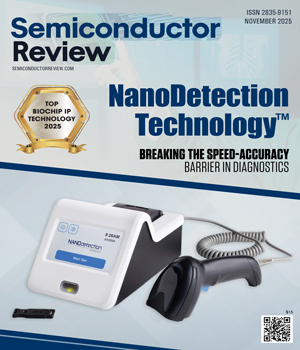
NanoDetection Technology™ has been recognized by Semiconductor Review Magazine as “Top Biochip IP Technology 2025” based on our proprietary methodology, reflecting its position in the industry. This profile has been developed by the Semiconductor Review research and editorial team based on insights from an interview with Douglas Durand, CEO and James Marous, Head of Engineering.


Diagnostics has always been about tradeoffs. Central laboratories deliver the highest sensitivity, but they come with delays and high infrastructure costs. NanoDetection Technology ™ (NDT) eliminates the trade-off through its next-generation diagnostic solutions for human and veterinary medicine.
Advancements in NDT have enabled laboratory-level diagnostic precision to be delivered at the point of care, providing not only faster results but also broader accessibility across diverse settings—at significantly lower cost.
The innovations of NDT center on its biochip; a technology originally developed at Oak Ridge National Laboratory in Tennessee. The biochip uses chemiluminescence-based sensing that captures light signals released during chemical reactions to deliver laboratory-grade precision in a compact, point-of-care system. Unlike traditional lateral flow tests, which rely on the human eye to read faint lines, the NDT biochip detects light many times below visual thresholds—many orders of magnitude fainter than the eye can register.
“Our sensitivity is such that from Earth we can detect signals as faint as a candle burning on the moon,” says Douglas Durand, CEO.
 The NDT biochip isn’t limited to one target at a time. Each unit contains 25 discrete light detectors, which means a single run can resolve up to 24 analytes along with a background channel. With multiplexing, entire biomarker panels can be scanned in a single run—streamlining workflows and replacing the inefficiency of test-by-test analysis.
That difference matters. For a clinician in an urgent care setting, infections that would otherwise slip past a rapid test can now be detected early. For veterinarians, it means detecting disease promptly to prevent herd disease, animal mortality or a virus outbreak. Field based diagnostics can use this to bring accuracy to settings far removed from centralized labs. Capable of running approximately 25 tests per hour NDT has made advanced diagnostics not only faster, but scalable and practical across diverse environments.
The design of the NDT diagnostic platform reflects an understanding of how testing is conducted in real-world conditions. Disposable test cassettes minimize the risk of contamination, streamline workflow and reduce costs. And results are produced in only minutes.
“The system is optimized for chemiluminescence today, but its architecture is also compatible with fluorescence and phosphorescence,” states James Marous, Head of Engineering at NDT. “So, if a lab is buying the instrument today, they are already covered for the assay formats of tomorrow.”
Researchers at the University of Kentucky are already evaluating the NDT system as a potential replacement for Western blot assays, with promising results. Tests that once took days can usually be completed in 30 minutes, while maintaining the sensitivity and specificity required to validate critical biomarkers such as Her-2/neu in oncology or p-tau 217 in neurology.
Our sensitivity is such that from Earth we can detect signals as faint as a candle burning on the moon
The NDT Difference
Several strengths converge with the NDT breakthrough. While sensitivity and specificity are two of its prominent takeaways, cost is the most decisive factor in driving faster adoption across clinical workflows. Disposable test cassettes cost just a dollar or two each. This affordability makes the system attractive to large hospitals and smaller clinics, including veterinary clinics, that often struggle to justify expensive diagnostic equipment.
 The design of the device makes a difference, too. Unlike some competitors, the biochip itself stays inside the instrument rather than being disposed of with each test. That single decision drives costs down and makes the system sustainable. The instruments do not require routine calibration, only one-time factory calibration, which eliminates ongoing maintenance overhead and significantly lowers operating costs. By reducing downtime and service demands, NDT ensures that clinicians can stay focused on patients, not on equipment upkeep.
Much of this advantage comes from the fact that the instrument was recently designed from the ground up by Lead Engineer, James Marous. Every element reflects a focus on usability, ruggedness and cost efficiency. Human factors were central to the development, producing a device with an intuitive interface that can be mastered quickly by new users. The result is a platform that is not only durable and affordable, but also remarkably easy to integrate into real-world workflows.
Flexibility deepens that impact. Each device is designed to run a broad range of tests without the need for tedious software updates, factory returns or costly technician site visits. A simple barcode carries the test instructions, enabling one system to fluidly shift from detecting methicillin-resistant Staphylococcus aureus (MRSA) to screening for avian flu to processing biomarker panels—all with the same reliability and speed. This flexibility means a single instrument can replace multiple specialized systems, reduce cost and simplify training.
MRSA is a major concern in hospitals and healthcare settings. Traditional lab methods can take days to confirm a diagnosis, during which time infections may spread or surgical plans may be delayed. NDT has developed a 10-minute MRSA assay that delivers sensitivity and specificity in the high 90 percent range. Physicians can move forward quickly and safely, backed by reliable data. For patients, this speed can mean shorter hospital stays, faster treatment and better outcomes.
A recent case shows the impact transferring an existing visually read lateral flow test from an NDT partner to the NDT system increased sensitivity 44-fold. That kind of leap, achieved with minimal optimization, highlights how the technology transforms the baseline of what’s possible in diagnostics. It also demonstrates how existing partner assays can gain new life and relevance when paired with NDT’s platform.
-
Optimized for chemiluminescence today, the system is also compatible with fluorescence and phosphorescence-ensuring labs are covered for tomorrow’s assay formats
A recent case shows the impact transferring an existing visually read lateral flow test from an NDT partner to the NDT system increased sensitivity 44-fold. That kind of leap, achieved with minimal optimization, highlights how the technology transforms the baseline of what’s possible in diagnostics. It also demonstrates how existing partner assays can gain new life and relevance when paired with NDT’s platform.
One Platform, Many Frontiers
 NDT’s system isn’t defined solely by what it can do, but also by how it is built. Every design choice reflects a balance of innovation and usability. The units are compact, rugged and equipped with a built-in printer for immediate reporting. These practical details make them as effective in crowded hospital labs as they are in mobile veterinary units. The NDT system is built for future incorporation into hospital laboratory software systems.
Beyond human and veterinary medicine, the same platform is being explored in food and animal feed safety. Contaminants like Salmonella or mycotoxins are often found after lab confirmation, by which time contaminants may already be in circulation. With the NDT system, the threats of contamination can be identified at the processing stage itself. That speed saves food and feed producers from the reputational and financial damage of recalls while strengthening the resilience of entire supply chains. For industries where timing determines both safety and profitability, this capability is transformative.
The platform’s versatility is opening new frontiers. In biodefense, it can deliver tools that detect threats in environments where speed and accuracy can shape critical responses. In research, NDT is advancing biomarker discovery through a partnership with the University of Kentucky, with focus on Alzheimer’s detection. Earlier insights in this area could reshape both diagnosis and care pathways, helping shift treatment from reactive to preventive approaches.
The NDT diagnostic test pipeline is growing. Work is underway on assays for highly pathogenic avian influenza and other emerging diseases. Each addition strengthens the value of the platform by expanding the menu of available diagnostics. As new threats emerge globally, the adaptability of the NDT system ensures it can quickly evolve to meet them.
Quality of its output is constantly being reinforced by supply chain control. Chip wafer production takes place in Germany, with final packaging completed in the US, ensuring reliability at a time when even leading diagnostic companies face shortages. The system is designed to withstand real-world conditions, where ease of use and consistency are just as important as innovation.
Scaling What Comes Next
 Leadership keeps the company’s vision focused and grounded on adoption. Doug Durand, who became CEO in 2022, after serving on the board since 2008, draws on over 26 years of experience in sales and marketing at Merck and AstraMerck. Dr. Samuel Lee, who joined in 2018, adds a blend of life sciences, physical sciences and computer sciences, sharpened by his track record co-founding Eikonoklastes Therapeutics and backing early-stage biotech ventures.
James Marous, MS, serves as Lead Project Engineer and brings more than 25 years of experience in the medical device industry, including numerous issued patents that showcase his innovation. He has been with NDT for 13 years, where his leadership in engineering and product design has been central to creating the company’s next-generation diagnostic platform.
In 2025, Edward Smith became part of the team, bringing decades of experience spanning diagnostics, pharmaceuticals, biotechnology and healthcare systems. As a pharmacist with an MBA, he bridges clinical understanding with business strategy.
Their combined experience strikes a balance between scientific rigor and commercial execution, a combination that has enabled the massive success of scaling a platform like NDT. By combining deep clinical expertise with proven commercial acumen, the leadership team is positioning NDT to meet the next wave of global diagnostic challenges.
The future of diagnostics is about acting with confidence. NDT’s platform delivers accuracy when every moment counts, shifting care from uncertainty to clarity.
| Share this Article:Tweet
|

Company
NanoDetection Technology™
Management
Douglas Durand, CEO and James Marous, Head of Engineering
Description
NanoDetection Technology™ (NDT) is redefining diagnostics through its biochip-based platform that delivers lab-level sensitivity at the point of need. Using chemiluminescence detection, the NDT System is at least forty times more sensitive than traditional visual tests, while providing results in minutes at a fraction of the cost of centralized lab equipment. Designed for flexibility, scalability and real-world usability, the platform supports applications across human health, veterinary medicine, agriculture, food safety and biodefense.
This content is copyright protected
However, if you would like to share the information in this article, you may use the link below:
https://www.semiconductorreview.com/nanodetection-technology