


Jack Feng
Almost all organizations recognize the benefits of Lean 6-Sigma or Operational Excellence (OPEX). Yet not many organizations have been successful in realizing the true benefits or sustaining the gains started earlier with the support of some external consultants or a few internal experts. Among the few most critical failure factors is lack of a model to manage the scale of breakthrough changes an OPEX journey entails. I am sharing some success stories based on my personal experience in deploying OPEX in three multi-national corporations (MNCs) – all in manufacturing with two in low volumes and high mixes environment and one in the current auto supplier within a high volumes and low mixes environment. Our success stories in sustainable deployment of the OPEX journey have been shared in Chapter 6 of Emerging Frontiers in Industrial and Systems Engineering (2019 by CRC / Taylor & Francis), and in Chapter 112 of the classic Maynard’s Industrial and Systems Engineering Handbook (6th Edition in 2023 by McGrawHill).
General Change Management Models A lot of publications centered around change management. Classic books include John Kotter’s Leading Change (2012) with an 8-step model more from the academic / consultant perspective, David Pttruck’s Stacking the Deck (2015) with a 9-step model more from a business executive’s perspective, and Jeanenne LaMarsh’s Changing the Way We Change (1995) with a 3-stage model more from a consultant’s perspective.
“Like any weight loss journey, every new movement is difficult to start, yet it is even more difficult to sustain weight loss by keeping up the same diet program, and by starting exercise to build more muscles”
Specific to the OPEX journey, four books stood out: Robert slater’s Jack Welch and the GE Way (1999), David Mann’s Creating a Lean Culture (3rd Edition, 2015), Art Byrne’s Lean Turnaround (2012), and Eric Ries’s Lean Startup (2011). Although Lean Startup focuses on starting a new business, I consider starting an OPEX journey within an existing organization similar to starting a new business.
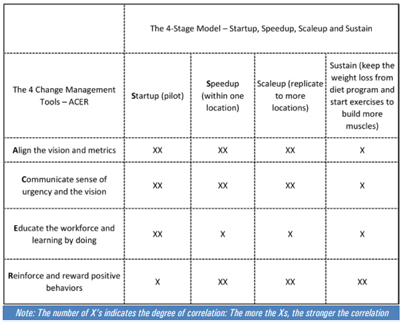
A Practical 4-Stage Model coupled with 4 Change Management Tools
After digesting the above and other models and based on my own experiments in leading large scale breakthrough changes, I offer a holistic and simplified approach for successful practical deployment. Like any weight loss journey, every new movement is difficult to start, yet it is even more difficult to sustain weight loss by keeping up the same diet program, and by starting exercise to build more muscles. Therefore, among the four change management tools, we view the first three tools critical to a successful startup or pilot
 After the first success at one program, say one casting machine, we need to Speedup the deployment to other casting machines or from casting machines to machining centers within one facility. Once we have success in the first replication within one facility, we naturally need the benefit of Scaleup by replication the same recipe to other facilities – first to the same process or processes such as from improving casting OEE to facility 1 to improving casting OEE at facilities 2 and 3. Within each of the Scaleup facilities, we should then Speedup by moving from one process to other processes.
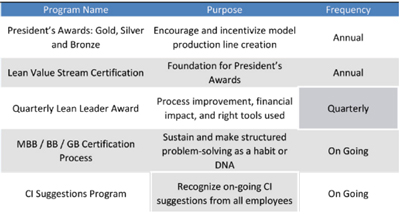
Five Change Management Programs to Sustain the Gains and Movement
The Sustain recipe should be the same for each success. We found the following five Change Management Programs extremely critical in our sustainability whether it is facilitywide, division-wide or corporatewide.
