
Thank you for Subscribing to Semiconductor Review Weekly Brief
× 
Semi Conductor Review Weekly Brief
Be first to read the latest tech news, Industry Leader's Insights, and CIO interviews of medium and large enterprises exclusively from Semi Conductor Review
High Purity Aluminum Distribution (HPA) has been recognized by Semiconductor Review Magazine as the exclusive recipient of “Top Semiconductor Material Supply Company 2026,” based on our proprietary methodology, reflecting its position in the industry, and is also named among “Top Advanced Material Companies,” reflecting its broader leadership. This profile has been developed by the Semiconductor Review research and editorial team based on insights from an interview with Laurence Goldfarb, President and Chief Marketing Officer.




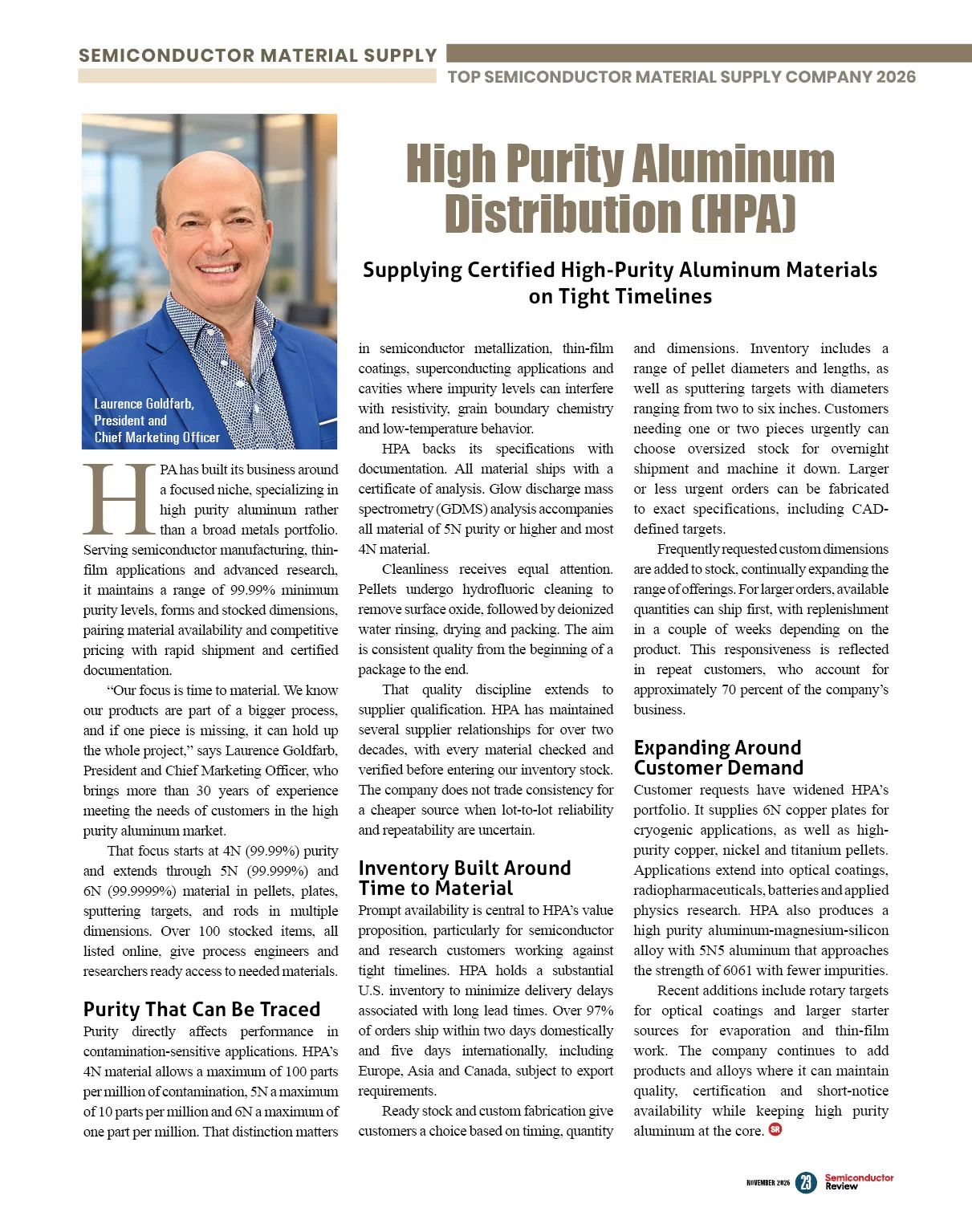
 Laurence Goldfarb, President and Chief Marketing Officer
“Our focus is time to material. We know our products are part of a bigger process, and if one piece is missing, it can hold up the whole project,” says Laurence Goldfarb, President and Chief Marketing Officer, who brings more than 30 years of experience meeting the needs of customers in the high purity aluminum market.
That focus starts at 4N (99.99%) purity and extends through 5N (99.999%) and 6N (99.9999%) material in pellets, plates, sputtering targets, and rods in multiple dimensions. Over 100 stocked items, all listed online, give process engineers and researchers ready access to needed materials.
Purity That Can Be Traced
Purity directly affects performance in contamination-sensitive applications. HPA’s 4N material allows a maximum of 100 parts per million of contamination, 5N a maximum of 10 parts per million and 6N a maximum of one part per million. That distinction matters in semiconductor metallization, thin-film coatings, superconducting applications and cavities where impurity levels can interfere with resistivity, grain boundary chemistry and low-temperature behavior.
HPA backs its specifications with documentation. All material ships with a certificate of analysis. Glow discharge mass spectrometry (GDMS) analysis accompanies all material of 5N purity or higher and most 4N material.
-
Our focus is time to material. We know our products are part of a bigger process, and if one piece is missing, it can hold up the whole project.
Cleanliness receives equal attention. Pellets undergo hydrofluoric cleaning to remove surface oxide, followed by deionized water rinsing, drying and packing. The aim is consistent quality from the beginning of a package to the end.
That quality discipline extends to supplier qualification. HPA has maintained several supplier relationships for over two decades, with every material checked and verified before entering our inventory stock. The company does not trade consistency for a cheaper source when lot-to-lot reliability and repeatability are uncertain.
Inventory Built Around Time to Material
Prompt availability is central to HPA’s value proposition, particularly for semiconductor and research customers working against tight timelines. HPA holds a substantial U.S. inventory to minimize delivery delays associated with long lead times. Over 97% of orders ship within two days domestically and five days internationally, including Europe, Asia and Canada, subject to export requirements.
Ready stock and custom fabrication give customers a choice based on timing, quantity and dimensions. Inventory includes a range of pellet diameters and lengths, as well as sputtering targets with diameters ranging from two to six inches. Customers needing one or two pieces urgently can choose oversized stock for overnight shipment and machine it down. Larger or less urgent orders can be fabricated to exact specifications, including CAD-defined targets.
Frequently requested custom dimensions are added to stock, continually expanding the range of offerings. For larger orders, available quantities can ship first, with replenishment in a couple of weeks depending on the product. This responsiveness is reflected in repeat customers, who account for approximately 70 percent of the company’s business.
Expanding Around Customer Demand
Customer requests have widened HPA’s portfolio. It supplies 6N copper plates for cryogenic applications, as well as high-purity copper, nickel and titanium pellets. Applications extend into optical coatings, radiopharmaceuticals, batteries and applied physics research. HPA also produces a high purity aluminum-magnesium-silicon alloy with 5N5 aluminum that approaches the strength of 6061 with fewer impurities.
Recent additions include rotary targets for optical coatings and larger starter sources for evaporation and thin-film work. The company continues to add products and alloys where it can maintain quality, certification and short-notice availability while keeping high purity aluminum at the core.
Assessing Semiconductor Material Suppliers for Purity and Availability
A semiconductor manufacturer may have a deposition process ready for production but still face delays because the specified metal grade is unavailable. Substituting a lower-purity material can introduce impurities that affect electrical properties, while waiting for a custom order may interrupt fabrication schedules. Material procurement consequently involves balancing purity requirements against availability without compromising process specifications. Suppliers must demonstrate that the material delivered meets the intended application's technical requirements and can be obtained within the required timeframe.
Purity specifications require closer examination than a headline percentage. Aluminum grades designated 4N, 5N or 6N represent different impurity limits, which can affect their suitability for sensitive electronic applications. A higher grade also carries a price premium that may not be justified for every component. Procurement teams should establish the required impurity thresholds with process engineers before approaching suppliers. Particular attention belongs to the elemental composition of residual contaminants rather than total purity alone. Two materials with similar stated purity may contain different trace elements, potentially affecting their behavior during deposition or subsequent processing.
Consistency between material lots can influence production results even when nominal purity remains unchanged. Manufacturers should examine supplier qualification procedures and the methods used to verify incoming stock. Trace element analysis provides a basis for confirming that purchased material meets established limits. Buyers also benefit from understanding how suppliers maintain repeatability across successive orders, particularly when fabrication processes are sensitive to small compositional differences. A lower quotation offers limited savings if unexpected variations require additional testing or process adjustments.
Product dimensions introduce another procurement tradeoff. Sputtering targets and evaporation materials must suit the equipment receiving them, while development programs may require uncommon geometries or small quantities. Custom fabrication can meet exact specifications but generally involves additional preparation and lead time. Stocked material that is slightly oversized may offer a faster alternative when the purchaser can perform final machining. Comparing suppliers therefore requires examining available forms and dimensions alongside their ability to manufacture components from customer drawings. Research laboratories often face different purchasing conditions from manufacturers ordering established quantities.
“High Purity Aluminum Distribution (HPA) provides certificates of analysis with every shipment and uses GDMS testing to verify trace impurity levels in materials graded 5N or higher.”
Inventory depth can determine whether material availability supports an accelerated development schedule. Suppliers maintaining a broad assortment of purity grades may fulfill urgent orders without waiting for upstream production. International shipping requirements can still affect delivery, particularly when customs procedures intervene. Buyers should distinguish stocked quantities from products listed as available for quotation. Repeat purchasing arrangements may also justify maintaining commonly requested dimensions, reducing the need for repeated custom orders. A supplier's ability to communicate replenishment schedules becomes relevant when initial quantities cannot cover an entire production requirement.
High Purity Aluminum Distribution (HPA) supplies aluminum in grades ranging from 4N through 6N, including pellets and sputtering targets for semiconductor applications. High Purity Aluminum Distribution (HPA) provides certificates of analysis with every shipment and uses GDMS testing to verify trace impurity levels in materials graded 5N or higher. Its inventory covers multiple dimensions, giving customers access to stocked products or custom fabrication based on specific drawings. The company also supplies selected high-purity alloys and evaporation materials, supported by established supplier qualification procedures. Its inventory approach accommodates urgent small orders alongside specialized requirements. Semiconductor manufacturers and thin-film research facilities requiring consistent material purity and short procurement lead times are particularly relevant buyers.
...Read more
Semiconductor Material Supply Companies Info
Q1
What Do Semiconductor Material Supply Companies Provide?
Semiconductor Material Supply Companies connect specialized manufacturing and research work with the metals and other inputs required for demanding processes. Their role can include sourcing defined purity grades, maintaining suitable forms and dimensions, supplying certified material and coordinating delivery. For applications where contamination can affect performance, material specifications and traceable documentation matter as much as availability. High-purity aluminum is one example of a material used in semiconductor metallization and thin-film work.
Q2
How Does HPA Support High-Purity Material Requirements?
High Purity Aluminum Distribution (HPA) concentrates on high-purity aluminum rather than maintaining a broad metals portfolio. It stocks material at 4N, 5N and 6N purity levels in pellets, plates, sputtering targets and rods, with more than 100 stocked items listed online. Its range also includes selected copper, nickel and titanium products. This focused inventory gives customers access to specified materials and dimensions for semiconductor, thin-film and research applications. For Semiconductor Material Supply Companies, maintaining that range requires close attention to stock depth and product specifications.
Q3
Why Do Purity Levels and Material Certificates Matter?
Semiconductor Material Supply Companies help users assess whether a material's purity is appropriate for a particular process. At 4N purity, the maximum contamination level is 100 parts per million; at 5N it is 10 parts per million, and at 6N it is one part per million. These distinctions can matter in metallization, coatings and other contamination-sensitive applications. Certificates of analysis support verification, while glow discharge mass spectrometry results provide additional analysis for higher-purity grades.
Q4
What Should Buyers Assess Beyond the Material Specification?
A suitable supply arrangement involves more than choosing a purity grade. Buyers may need to consider lot consistency, surface cleanliness, available dimensions, documentation and the time required to receive stock. Semiconductor Material Supply Companies should be able to explain how material is checked before shipment and what evidence accompanies it. HPA, for example, supplies certificates of analysis with all material and uses cleaning, rinsing and drying steps for its aluminum pellets before packing.
Q5
How Can Inventory and Fabrication Affect Project Timelines?
Having materials available can keep production or research on schedule. HPA keeps a large U.S. inventory and offers both ready-to-ship stock and custom-made items, including targets built to CAD specs. Over 97 percent of orders ship within two days in the U.S. and within five days internationally, depending on export rules. For urgent jobs, larger stock can be cut to size, and big orders can be shipped in parts. These options help Semiconductor Material Supply Companies handle different order sizes without treating every request the same way.
Q6
Which Applications Are Served by Semiconductor Material Supply Companies?
The category supports work that depends on reliable access to specialized materials, from semiconductor manufacturing to thin-film coatings and advanced research. HPA's products are also used in superconducting applications, optical coatings, cryogenic work, batteries and applied physics research. Its portfolio has expanded to include copper plates and selected specialty metals, while high-purity aluminum remains its central focus. When evaluating suppliers, organizations can compare material range, purity evidence, inventory depth and fulfillment capabilities against the needs of each application. Semiconductor Material Supply Companies are most useful when those supply details align with the process requirements and delivery schedule.
| Share this Article:Tweet
|

Company
High Purity Aluminum Distribution (HPA)
Management
Laurence Goldfarb, President and Chief Marketing Officer
Description
HPA supplies certified high purity aluminum and selected specialty metals for semiconductor, thin-film, research and advanced technology applications. Its focus on documented quality, deep inventory and rapid fulfillment helps specialists secure required materials without delaying larger processes.
This content is copyright protected
However, if you would like to share the information in this article, you may use the link below:
https://www.semiconductorreview.com/high-purity-aluminum-distribution-2026