
Thank you for Subscribing to Semiconductor Review Weekly Brief
× 
Semi Conductor Review Weekly Brief
Be first to read the latest tech news, Industry Leader's Insights, and CIO interviews of medium and large enterprises exclusively from Semi Conductor Review
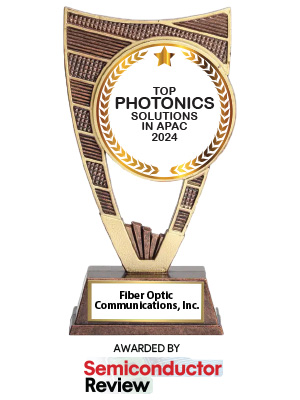
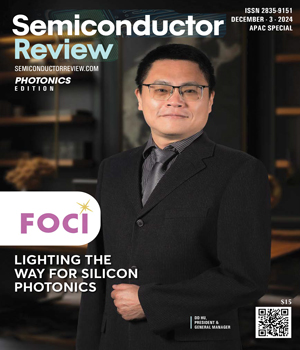
Fiber Optic Communications, Inc. has been recognized by Semiconductor Review Magazine as “Top 10 Photonics Solutions in APAC - 2024” based on our proprietary methodology, reflecting its position in the industry. This profile has been developed by the Semiconductor Review research and editorial team based on insights from an interview with DD Hu, President and General Manager .



Fiber Optic Communications, Inc.
Lighting the Way for Silicon Photonics

 DD Hu, President and General Manager
 But merging the speed of light with the processing power of these chips is more complex than it seems. Aligning optical fibers with the tiny waveguides on silicon photonic chips requires pinpoint precision. Without a standardized connector, manufacturers face prolonged design cycles, higher costs and inconsistent quality—major obstacles in today’s fast-paced tech landscape.
Fiber Optic Communications, Inc. (FOCI) is tackling these challenges with its reflowable lensed fiber array connector, ReLFACon.
ReLFACon provides an accurate and reliable method for integrating optical fibers with silicon photonic chips, establishing a new benchmark for precision in the industry. The process is simplified with customizable fiber array soldering, connector characterization and precise packaging. FOCI’s streamlined approach unifies previously disjointed workflows, ensuring manufacturers achieve consistent, scalable results while reducing time and costs.
“It’s not just about making a physical connection; it’s about optimizing data transfer from fiber optics to photonic integrated circuits with maximum efficiency,” explains DD Hu, president and general manager of FOCI.
 Hu’s leadership and extensive background have been pivotal in ReLFACon’s development. His academic journey began at the National Taiwan University, where he earned degrees in physics and electrical engineering before building an impressive career in the semiconductor industry. From managing advanced processes at Taiwan Semiconductor Manufacturing Company (TSMC) to overseeing chip scale packaging at Xintec and working in optical technologies at Centera, Hu has accumulated a wealth of knowledge. His understanding of both optical and semiconductor technologies shaped the design of ReLFACon, positioning it as a game-changer in the integration of fiber optics and silicon photonic chips.
“As a Taiwan-based manufacturer, we are a key player in photonics and co-packaged optics for high-performance computing and high-bandwidth networking. We provide complete, end-to-end solutions that meet the growing demand for high-bandwidth applications, from design through manufacturing,” adds Hu.
FOCI supports its innovations with a full suite of photonic assembly services, including precise lens and chip bonding, as well as active alignment bonding. It also offers a wide array of fiber optic components, such as polarization-maintaining fibers (PMF), single-mode fibers (SMF), isolators, splitters, wavelength division multiplexers and optical cable assemblies, making it a comprehensive provider of advanced optical network solutions.
Small Space, Big Impact
This advancement aligns with the broader shift in data infrastructure. As data centers push the limits of bandwidth, the transition from traditional copper interconnects to optical solutions is inevitable. ReLFACon fits seamlessly into this evolution, offering an automated and standardized approach that simplifies production. Unlike custom, manually assembled components, ReLFACon enables scalable, efficient manufacturing—paving the way for next-generation integration.
With expertise in PMF/SMF, alongside precise alignment and miniaturized form factors—critical for meeting future high-bandwidth demands—FOCI addresses the full spectrum of challenges in photonic integration. By working closely with leading chipmakers in AI and high-speed networking, as well as prominent foundries in Taiwan, FOCI ensures its solutions are tailored to real-world needs. The company’s engineers regularly collaborate with customers through virtual and in-person meetings to co-develop solutions that meet specific requirements. These prototypes undergo rigorous testing and refinement, ensuring the final product aligns perfectly with customer expectations.
Space is a premium commodity in modern photonic systems, where maximizing efficiency is essential. ReLFACon meets this challenge by pushing the boundaries of integration with its compact yet powerful design.
At just seven millimeters wide, this tiny glass component is a marvel of engineering. The compact size allows multiple fiber arrays to seamlessly integrate onto a single chip. With space for up to eight to 10 units along one side of a photonic integrated circuit (PIC), ReLFACon redefines the potential for high-density applications.
Engineered to endure the high temperatures of reflow soldering without losing integrity, ReLFACon fits flawlessly into standard manufacturing workflows, making it easy for manufacturers to adopt on a large scale. Crafted to outperform in rigorous settings, ReLFACon pushes integration further without compromising reliability or efficiency.
The power of ReLFACon lies in how it transforms data connectivity. By eliminating breaks in data transmission and providing a direct optical path to computing systems, it supports uninterrupted, high-speed data flow. In industries where milliseconds matter, ReLFACon ensures data flows seamlessly. That’s crucial for unlocking greater computing potential and meeting rising performance demands.
It’s not just about making a physical connection; it’s about optimizing data transfer from fiber optics to photonic integrated circuits with maximum efficiency
This advancement aligns with the broader shift in data infrastructure. As data centers push the limits of bandwidth, the transition from traditional copper interconnects to optical solutions is inevitable. ReLFACon fits seamlessly into this evolution, offering an automated and standardized approach that simplifies production. Unlike custom, manually assembled components, ReLFACon enables scalable, efficient manufacturing—paving the way for next-generation integration.
“With photonics integration, we’re now able to go from fiber directly to the chip. We provide the entire solution—from cabling to soldering the ReLFACon connector onto the PIC, which can then go through the reflow process. This eliminates the need for transceivers or any intermediate links between systems,” says Hu.
Collaboration at Its Core
Having a good product is no longer enough. Making a real impact requires collaboration, innovation and manufacturing scalability, all of which FOCI understands well. ReLFACon exemplifies this by providing a universal interface for fiber attachment, simplifying design complexities and accelerating development cycles. Standardization further streamlines production, resulting in faster time-to-market, improved yields and reduced bill of materials (BOM) costs—benefits that positively influence the entire supply chain.
-
We provide complete, end-to-end solutions that meet the growing demand for high-bandwidth applications, from design through manufacturing
With expertise in PMF/SMF, alongside precise alignment and miniaturized form factors—critical for meeting future high-bandwidth demands—FOCI addresses the full spectrum of challenges in photonic integration. By working closely with leading chipmakers in AI and high-speed networking, as well as prominent foundries in Taiwan, FOCI ensures its solutions are tailored to real-world needs. The company’s engineers regularly collaborate with customers through virtual and in-person meetings to co-develop solutions that meet specific requirements. These prototypes undergo rigorous testing and refinement, ensuring the final product aligns perfectly with customer expectations.
Automation plays a key role in supporting customization and scalability. FOCI has made significant strides in transitioning from manual processes to fully automated assembly lines, particularly for high-density fiber array connectors like ReLFACon, enabling it to meet large-scale production demands while reducing the risk of human error. The enhanced efficiency and scalability enables it to deliver millions of units with consistent quality and precision.
“Our focus on automation has positioned FOCI as one of the trusted partners within TSMC’s supply chain. ReLFACon plays a pivotal role in TSMC’s co-packaged optics initiatives for AI, machine learning and high-speed networking by providing a direct optical path from fiber to chip, removing the need for transceivers,” says Hu.
In addition to its innovations, FOCI is committed to its environmental, social and governance (ESG) responsibilities. It received the ESG Gold Medal from ChungHwa Telecom, Taiwan’s leading operator, in recognition of its sustainable practices. FOCI developed an ESG code of practice that aligns with Taiwan’s Stock Exchange and global sustainability trends. The code applies across all operations, promoting a balance across ESG while contributing to economic growth and the well-being of employees and communities.
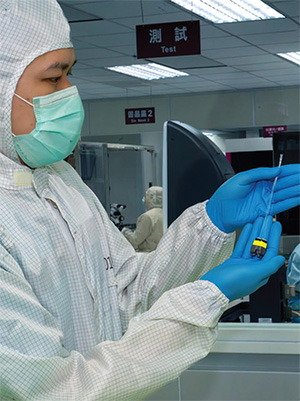
FOCI’s corporate responsibility includes conducting ESG-related risk assessments, developing strategies to mitigate these risks and promoting transparency in its ESG practices, which includes ethical business practices and stakeholder engagement. Regular third-party reviews ensure FOCI’s ESG practices continue to evolve and meet both domestic and international standards.
Paving the Path to Photonic Power
With over 30 years of expertise in fiber optics, FOCI continues to advance innovation from its base in Hsinchu Science-Based Industrial Park in Taiwan. The team is strengthened by the recent inclusion of specialists in IC design, processing and packaging, further driving the company’s capabilities in developing advanced photonic solutions.
FOCI is working closely with its customers to build production capacity and deliver the next generation of ReLFACon, with a focus on highly automated and precise manufacturing processes. These advancements will ensure it can meet the growing demands for high-performance photonics across various industries.
Looking ahead, FOCI will expand the use of its PICs, including them into applications such as automation and autonomous driving. ReLFACon will also play a crucial role in supporting car autopilot systems, powering self-driving and other advanced automotive technologies.
Under DD Hu’s leadership, ReLFACon has redefined how fiber optics integrates with silicon photonic chips, setting new benchmarks for efficiency and scalability. The compact, reflowable connector addresses industry challenges and opens doors to future applications. As FOCI continues to innovate, it is well-positioned to shape the next wave of high-performance computing and advanced photonic systems.
| Share this Article:Tweet
|
Company
Fiber Optic Communications, Inc.
Management
DD Hu, President and General Manager
Description
Fiber Optic Communications, Inc. (FOCI) is a Taiwan-based leader in photonics and fiber optics, specializing in innovative solutions like ReLFACon for silicon photonics integration. With over 30 years of expertise, FOCI delivers high-performance products that drive advancements in industries such as AI, high-speed networking and autonomous technologies.
This content is copyright protected
However, if you would like to share the information in this article, you may use the link below:
https://www.semiconductorreview.com/fiber-optic-communications-inc