
Thank you for Subscribing to Semiconductor Review Weekly Brief
× 
Semi Conductor Review Weekly Brief
Be first to read the latest tech news, Industry Leader's Insights, and CIO interviews of medium and large enterprises exclusively from Semi Conductor Review
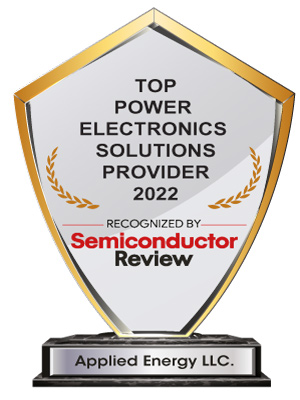
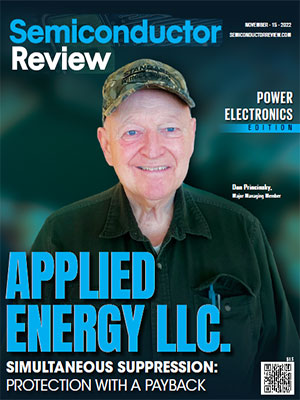
Applied Energy LLC. has been recognized by Semiconductor Review Magazine as “Top 10 Power Electronics Solutions Companies - 2022” based on our proprietary methodology, reflecting its position in the industry. This profile has been developed by the Semiconductor Review research and editorial team based on insights from an interview with Bill Hinton, Director of Engineering and Dan Princinsky, Major Managing Member.



Applied Energy LLC.
Simultaneous Suppression: Protection With a Payback

 Bill Hinton, Director of Engineering and Dan Princinsky, Major Managing Member
At the moment of a voltage imbalance between phase and ground, the VSGR provides a phase voltage equalization to keep voltages equal within 1 to 2 volts. With the VSGR, harmonic distortion also becomes a non-issue: the VSGR is a proven means of reducing phase voltage harmonics at all frequencies. If phase angles are not equal, the VSGR adds a correction to provide equal phase angles for each phase voltage. This ensures that each of the three phases does one third of the work. Conventional power quality devices cannot do these things, and they do not provide this equal division of work.

The VSGR has also been tested against arc flash events. At a high-power test laboratory, the VSGR was connected in parallel with an operating 480 volt 3- phase load power circuit. The circuit was hit with voltages ranging from 2,500 to 8,400 volts for duration 750 times longer than a SPD is tested for. There was no arc flash, nor was there any damage dealt to the VSGR, a power system with a voltage imbalance exceeding two percent.
Conventional “solutions” will not stand the test of time and cannot compete: the VSGR provides real-time corrections for all power quality problems at the beginning of an event, and will continue to do this for over 35 years, even in environments with high electrical noise.
“Applied Energy’s policy is to provide Protection with a Payback: the resulting clean power provided by Applied Energy LLC’s patented products will generally result in a payback or ROI of less than one year,” says William Hinton, the Director of Engineering at Applied Energy LLC.
Applied Energy LLC is a total solution provider of surge suppressing, voltage stabilizing ground reference devices.
Applied Energy LLC was formed in 2002 with the goal of eliminating the problems caused by transient overvoltage events such as ground faults. In 2002, these problems cost the U.S. over 30 billion dollars annually. That number is now over 150 billion dollars annually.
Applied Energy, LLC is the world’s only complete solution provider for maximizing power quality in AC and DC applications. The Phaseback VSGR prevents ground fault and arc flash events, saves energy, and minimizes harmonic distortion, all while providing a tangible, short-term payback, typically within one year of implementation.
With a combined total of over eighty four years of experience working in the field, both Dan Princinsky and Bill Hinton decided it was time to address the cause of the problem, not its effects. The Voltage Stabilizing Ground Reference (VSGR) was created with the sole intent of preventing arcing ground faults for an industrial customer’s facility. This customer had lost 24 motors in a 90-day window due to ground faults. Upon implementation of the VSGR, the problem ceased entirely. Since then, we have discovered that in order to prevent all of the most common power quality issues, the voltage potential between phase and ground must be kept in balance.
The competing products are not designed to react at the speed of the current flow, meaning there is a built-in delay in reaction before attempting to control the voltage waveform
The Capability Presented by Phaseback
Phaseback is beneficial to all aspects of electrical industry: all loads are powered from the same power grid. The VSGR prevents damage from voltage spikes, reduces heat caused by harmonics, prevents lockups in drives and controls caused by electrical interference, and stabilizes the switching functions in UPS systems. The VSGR even protects LED lamps from electrical damage and burnout.

Think about the diodes and transistors in computers, computer servers and data centers, there are literally thousands of P/N junctions in every one as half the time they operate as conductors and half the time they operate as insulators and both operation modes are damaged by voltage spikes.
Adding (1) VSGR to each power transformer provides the life expectancy they were designed for. Yes, LED lights really can and do last 10 to 20 years when operating 3-phase load, or the power transformer powering this circuit.
In a 3-phase power circuit, power quality problems can only be prevented by instantly and continuously equalizing the voltages between phase and ground. Testing data has proven the VSGR will:
The VSGR is the only power quality product which comprehensively cleans and equalizes electrical power. With clean power, motors run cooler, and electrical consumption automatically drops by 5 to 20 percent. The VSGR is built to last: with no solid state components, it is engineered to perform for 35 years.
• Reduce harmonic energy by 85 percent
• Correct phase angle distortion from >12 degrees to ±1 degree
• Correct phase to ground voltage imbalances from >20 to within 1 percent
All of this is performed at the speed of the flow of current (186,000 miles per second). In the case of many competing power quality devices (HRG, NGR, Zigzag transformers, insulation monitors, ground detectors and SPDs), there is a delay until the voltage builds up to the clamping voltage level, as well as a reaction time. Even if this lasted only 1/10th of a second, the spike in voltage could travel 1,860 miles by the time these devices provide a reaction.
“These competing products are not designed to react at the speed of the current flow, meaning there is a built-in delay in reaction before attempting to control the voltage waveform,” says Hinton.
The Only Power Quality Product
Other technologies claim to provide a solution for individual power issues: one for spikes, one for harmonics, and another for limiting AC current feeding each drive. However, none of these provide balanced voltages, which can lead to voltages spiking outside the CBEMA curve: the IEEE has determined that motors should be powered from a voltage spike free power system with a maximum voltage imbalance of two percent.
-
Applied Energy’s policy is to provide Protection with a Payback: the resulting clean power provided by Applied Energy LLC’s patented products will generally result in a payback or ROI of less than one year
The VSGR is the only power quality product which comprehensively cleans and equalizes electrical power. With clean power, motors run cooler, and electrical consumption automatically drops by 5 to 20 percent. The VSGR is built to last: with no solid state components, it is engineered to perform for 35 years.
The Phaseback VSGR was designed, developed, tested for over 19 years, manufactured, and patented by Applied Energy LLC. Patent reference at the USPTO: 10,985,648 B2 (SYSTEMS AND METHODS FOR POWER MONITORING AND CONTROL).
| Share this Article:Tweet
|
Company
Applied Energy LLC.
Management
Bill Hinton, Director of Engineering and Dan Princinsky, Major Managing Member
Description
Applied Energy LLC is a total solution provider of surge suppressing, voltage stabilizing ground reference devices. Applied Energy LLC was formed in 2002 with the goal of eliminating the problems caused by transient overvoltage events such as ground faults. In 2002, these problems cost the U.S. over 30 billion dollars annually. That number is now over 150 billion dollars annually
This content is copyright protected
However, if you would like to share the information in this article, you may use the link below: